Total Pageviews

Sunday, October 16, 2011

Racket Guard

Today the badmintong and tennis rackets are light weight. The frames can be of steel, aluminium, carbon firbre, graphite, ceramic, boron or a combination of some of these. Japanese brand rackets such as Yonex is the premeir manufacture of badminton rackets. Popular western brands are Dunlop, Wilson and others.


                             cheap wooden badminton racket from Pakistan


                                             wooden tennis racket


a wooden tennis racket within  a racket guard

In the 1950s and 1960s badminton and tennis rackets were made of wood and was quite heavy. The western world monopolised the premier manufacture of the rackets. The good brands were Head, Wilson, Dunlop, Prince, Donnay etc. The cheap ones were from India and Pakistan. Unfortunately, the wooden badminton racket as well as tennis racket wobbled out of shape due to the weather. Therefore, a racket was always kept in a racket guard when not in use as in the above photo.

That was the way we were when playing racket games.

Monday, October 3, 2011

Bucket Latrine

 What is a bucket latrine? To those who has no idea what it is, a picture is worth more than a thousand words.
Sketch of a bucket latrine

Bucket latrines outside a factory

                                 Night soil worker carrying night soil buckets
at Joo Chiat Road

In the early 1960s most shophouses outside the city used bucket latrines for disposal of human wastes. The latrine was usually located at the extreme end of the house so that removal of the night soil bucket could be carried out from the backlane. In the case of 3 storey back to back houses in China town, there were inadequate latrines in each floor. As a result the night soil buckets were often filled to the brim and waste liquids dripped all the way from the upper floor down the staircases to the ground level. Imagine the stinking smell the tenants had to bear daily.

A bucket latrine converted to wc squat pan.

Later sewers were laid in the backlanes and house owners had to convert a bucket latrine into a water carriage system squat pan as in the above photo.

My house had about 10 people living together. The night soil bucket was not only often full but also stink. I was forced to light a cigarette to counter the melodorous assault. My mother smoked and I took her tobacco to roll my own cigarettes.


That was the way we were!

Tuesday, August 23, 2011

Joo Chiat Road In The Past

Last month my son and his family flew in from US to visit us. I took the opportunity to show my grand daughter her Joo Chiat heritage. I walked down memory lane once more. It was a sentimental journey to relive the past. The vacant land between Joo Chiat Terrace and the Joo Chiat Complex evoke fond memories. On that piece of land once stood a block of 2 storey shophouses where I lived. Chew Joo Chiat's house was in the block of 3 storey building. The two blocks of buildings were separated by a lane leading to Langsat Road.

Behind my house was a small kampong where Chinese, Malays and Indians lived in harmoney. I had Malay playmates and learnt to speak Malay and played dum (Malay board game) with them. One of them, his father made very good chepak (leather slippers) for me. He also made songkoks and supplied them to the shops for sale in Geylang Serai. Another, his mother not only spoke Chinese dialect but also played si seks (4 coloured cards) and mahjongs with her Chinese neighbours. We grew up together. Yusof became a police detective and Ramlee a postman.

I lived in Joo Chiat Road from the day I was born till 1957. It was also my growning up years. The Pacific War ended with the return of the British. Singapore was then under the British Military Administration aka BMA. There was food rationing and black markets were thriving. Many people was out of job. There was a sudden mushroom of hawkers, especially cigarettes stalls. They were at street corners, roadsides and pavements.

Joo Chiat Road from Joo Chiat Place towards Geylang Serai was a very busy place. There were 2 wet markets side by side. One was facing Joo Chiat Road and the other was facing Changi Road. Lining both sides of the road were shops selling a wide variety of consumer goods including Chinese medical shops, clinics, dentists, tinsmiths, photo studios etc etc.

There was also an open air cinema known as Lily Cinema. It showed Chinese, Malay and Indian movies. It had wooden benches without back rests. An unwritten rule allowed movie goers to reserve seat by tying a handkerchief to the bench. During a popular movie show the benches were full of handkerchives. Late comers were frustrated at such a sight resulted in quarrels and fights.

My house was at Joo Chiat Road and my bedroom was facing the road. Each morning about 5.00 am onwards I could hear the 'click clock' noise
from the wooden clogs worn by housewives on their way to the markets. As the morning got brighter the noise increrased in intensity as more housewives charged to the markets. I got used to the noise disturbance and made it my alarm clock each morning to get ready for school and later for work.

My house frontage had a recess from the road. Food hawkers set up stalls for breakfast. Housewives gathered to socialise and gossip. Some remained until the announcement of 'chap jee ki' result. I observed their faces. Very few smile but majority frown with disappointment.

Nearby my house was a sidelane crowded with hawkers selling fresh fish from the kelongs, vegetables and fruits from our local farms and cooked food such as mee siam, bachor mee, prawn mee soup and others. Our family owned the land. Each hawker paid a fee including water supply. On week-ends and public holidays I was on duty. Occasionally I barter with the hawker for a plate of mee siam, or a bowl of mee.

During the night a popular hawker stall selling satay and porridge aka choke in Cantonese occupied the frontage of my house. Every night after the open air cinema show ended, streams of movie goers walked pass my house. Many stopped by to have supper. Due to its popularity the hawker stall had become an icon in Joo Chiat Road.

My next door neighbour was a tyre shop. The owner had a Ford car and every morning drove his car to his other shop in town. In the morning on my way to school I had the opportunity to watch him starting his car. Today we started the car engine by the turn of a key. It was very laborious then. First the driver took a crank rod from the car. The metal rod had a 'z' shape with one end longer than the other. Next he walked to the front and pushed the longer end through a hole under the radiator to connect it to the main shaft. He used the shorter end as a handle to crank start the car engine in clockwise motion. He could never start the car engine with one go. Strength was needed to crank up the car engine and doing it continuously a few times could be very tiring. Once the car engine started, he pulled back the metal rod and put it back to the side the car.
Finally he drove the car away. It was a daily ritual for him.

Photo from PICAS Background on the left, a red arrow shows a lane leading to the open air Lily Cineman.
A white arrow in the centre shows the side lane that led to Langsat Road.
In the morning it was like a wet market crowded with people


Wednesday, July 27, 2011

Jurong Bird Park

Jurong Bird Park was opened on 3rd January 1971 by Dr Goh Keng Swee, then Minister of Defence. It is now the largest bird park in the world with 20 hectares of land area for about 5000 birds with 380 species. One of its main attraction is the bird show.

Fast rewind 40 years back, I brought my family to Jurong Bird Park for the first time. My children were all below 10 years old then. We did not know what attractions there were at a bird park. But, we knew for sure that there were many birds to feast our eyes. It was a hot sunny day and we were sweating profusely. The children enjoy running around the big open space but I was looking in vain for a shade. There was not a single tree that was good enough to provide a cover for us to cool down. Maybe the instant trees in the public parks today were not implemented yet. The black and white photos below showed the bird park's wide open ground without trees. I remember there was a aviary with a waterfall within it. All the big birds were in cages but the flamingoes and the pelicans had their own pools. The penguins were in a special enclosure. The children loved to watch them walked in a swinging motion before diving into the water. There was a tram with a few open carriages for a quick look around of the park. We preferred to walk and see the birds at close range.

Recently, we visited the bird park with my son and his family. It was a nostalgic visit after 40 years. My son was a boy then. During the recent visit he brought his 2 children with him. It is like history repeating itself. The present bird park is a world of difference from the 70s. The bird park now has many tall trees and there is no lack of shady places whether under the trees or at the eateries. An above ground panorail (monorail) has replaced the tram for a quick look around. In addition there are a few golf carts with a guide each for hire. We booked one golf cart to cover as many attractions as possible as we wanted to avoid the afternoon heat. The cart driver was also our tour guide. She gave commentaries about the birds such as their country of origin, species, habitats etc. We were wiser at the end of the tour. The two main attractions for us were feeding the birds and the bird show. I do not remember there was a bird show in 1971. I enjoyed the visit and wonder when will be the next one.


Pictures of Jurong Bird Park in 1971


Photo credit to NAS


Golf cart tour


Photo credit to NAS


Penguins enclosure then and now


Photo credit to NAS


African waterfall aviary then and now


Feeding the birds


Birds show


a photo to remember

Thursday, June 2, 2011

Lor Arh (Braised Duck)


Lor Arh (braised duck) stall


Above lor arh (braised duck) stall is currently selling at Queen Street Food Centre. On the left hand corner of the photo is a picture of a pushcart and written on the attap roof four Chinese characters (六十年代) meaning the stall has been in lor arh (braised duck) business for 60 years. I was disappointed when the stallholder answered me that he was not aware of the 'si go luck' dice game that accompanied the lor arh business before. He did not look very old, so I assumed that 60 years ago, his father was the hawker and not him.


Today's gourmet has to travel to a food centre or an eating house to eat lor arh or braised duck. In the 50s and 60s the reverse was true. The itinerant lor arh hawker would come to your door announcing his braised duck "lor arh, lor arh!".


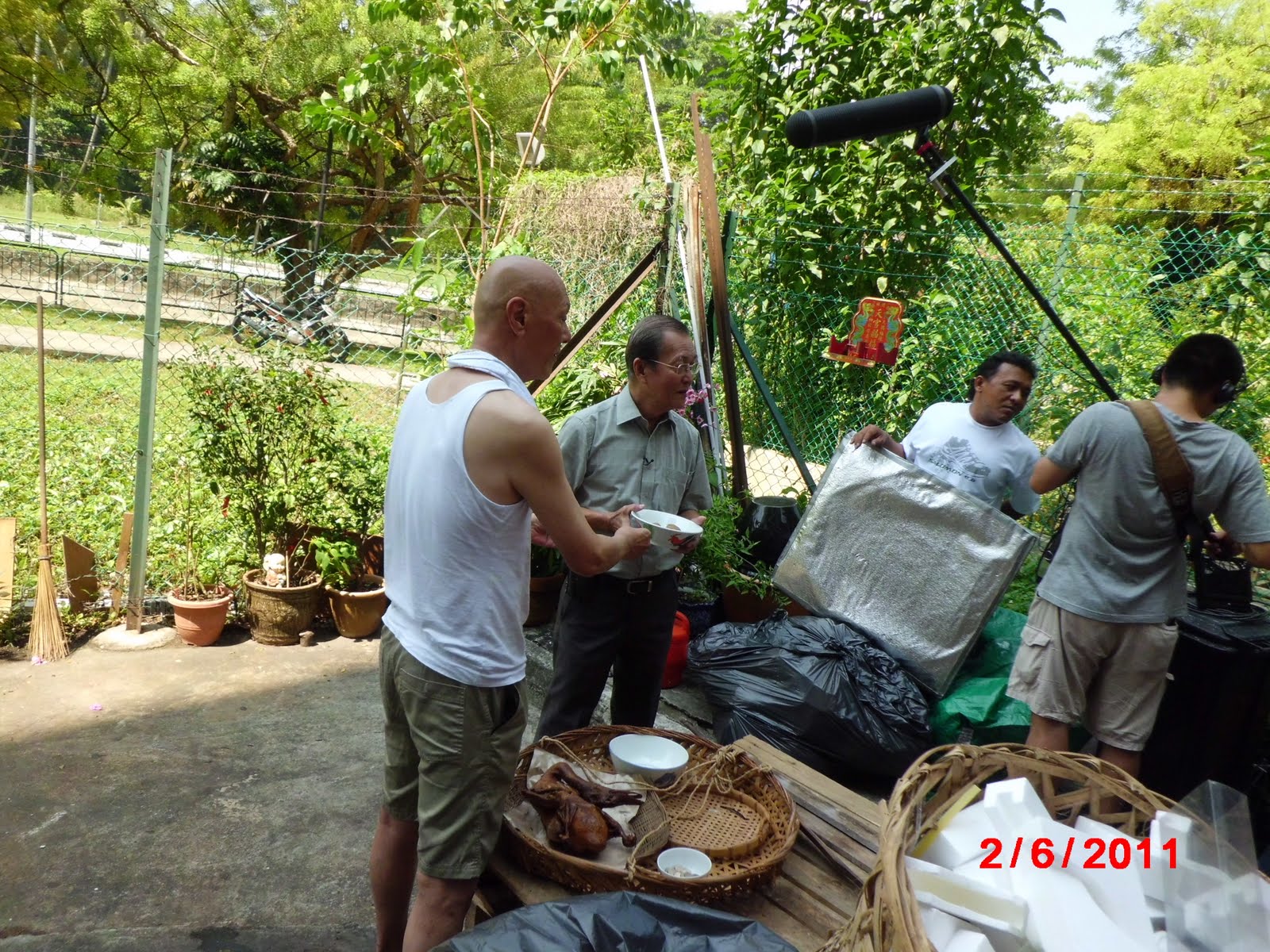
Recently, a fellow blogger Jame Seah and I had the opportunity to act a lor arh hawker and his customer as in the old days, for a tv documentry on Heritage Food. The scene acted out was nostalgic and unique because only the lor arh hawker would play a game of dice with his customer, giving him a chance to win the braised duck instead of buying directly from him.


Lor Arh vendor and a customer getting ready for action


Sound, Lighting, Camera & Action!


Itinerant hawker acted by James Seah
Customer played by Philip Chew


Above picture shows only the main stuff - braised duck, egss and dices in a bowl for the game.


The Dice Game (4,5,6 or si go luck in Hokien)


Three dices are used. The customer throws the dices first into a bowl and let them roll. The dices must resulted in a paired number (say two 3s) and a single/challenged number (say 4). When there is no paired conbination, the player must continue to play the dices until there is a result. If the 3 dices show number 1, 2 and 3, or a pair with the challenged number 1, the customer loses outright. That is the odd against him. If he wins the first round, he has to continue playing until he wins the best of 3 games to claim his prize of 3 eggs. He could return the 3 eggs to play for a quarter duck, and then to half a duck and finally the whole duck. For each bet he must win the best of 3 games. The basic price per game was 30 cents for the prize of 3 eggs. A customer could pay more to play for a quarter duck instead of starting with the basic 30 cents for 3 eggs.


Fast rewind back to the 50s and 60s at Joo Chiat.


Every Sunday my home was like a club house. My friends, mostly shopkeepers in the vicinity gathered to drink beer, hard liquor and played mahjong and cards. That was where I learned all the vices as a teenager. The itinerant braised duck hawker usually arrived at my house about lunch time. His mobile stall had lor nun (eggs) and lor arh (braised ducks), plus gizzards etc. He gave free sauce(lor), cucumber and chilly sauce. Many of us took turn to play against him until somebody won a whole duck or two and some eggs. Unlike today's hawker stall where you can buy a bowl of rice or porridge, this guy had no rice at his stall. Anyway, no rice was fine with us drinkers. I remembered there was one or two occasions we won all his ducks, eggs and all. He did not mind at all for we lost to him a sum of money which could be more than the cost of his goods. The players had the satisfaction of winning the briased ducks and the hawker was happy to make more money by playing the game of dice. It was a win win situation for both. No wonder it was so popular in those days.

Friday, January 28, 2011

Yer Of The Rabbit


Wishing You A Happy & Blessed Chinese New Year of Golden Rabbits

Friday, January 21, 2011

Time Stood Still in Galle, Sri Lanka

In Galle, Sri Lanka there was a very old open shed market built in 1880 named Green Market. The building had slim rounded concrete pillars and raised cement floors with a lower passageway in the centre, separating the market into two equal parts.

I saw only local farm produce such as vegetables, chillies, carrots, pumpkins tubers, etc were sold there. Not a single item was imported. All articles were displayed for sale on the flat floor. The stallholders still used the old type of weighing scale as shown in the pictured below.

Times moved on but the Green Market did not. Business was as usual since the market first started. The only thing that changed was the stallholders. They were the new generations, probably the descendants of the old hawkers. Walking inside the market was like going back in time. It amazed me that time stood still for this 19th century market although it was within walking distance of a busy shopping street.

The hawker stalls outside the market were different. They had raised stalls and displayed their articles at eye level so that the customers did not have to look down like those inside the market.


Green Market 1880


Articles displayed on the floor


Balancing weighing scale


Metal weight in grams


Stall outside the market and busy shopping street in the background


More stalls outside the market