Total Pageviews

Thursday, June 2, 2011

Lor Arh (Braised Duck)


Lor Arh (braised duck) stall


Above lor arh (braised duck) stall is currently selling at Queen Street Food Centre. On the left hand corner of the photo is a picture of a pushcart and written on the attap roof four Chinese characters (六十年代) meaning the stall has been in lor arh (braised duck) business for 60 years. I was disappointed when the stallholder answered me that he was not aware of the 'si go luck' dice game that accompanied the lor arh business before. He did not look very old, so I assumed that 60 years ago, his father was the hawker and not him.


Today's gourmet has to travel to a food centre or an eating house to eat lor arh or braised duck. In the 50s and 60s the reverse was true. The itinerant lor arh hawker would come to your door announcing his braised duck "lor arh, lor arh!".


Recently, a fellow blogger Jame Seah and I had the opportunity to act a lor arh hawker and his customer as in the old days, for a tv documentry on Heritage Food. The scene acted out was nostalgic and unique because only the lor arh hawker would play a game of dice with his customer, giving him a chance to win the braised duck instead of buying directly from him.


Lor Arh vendor and a customer getting ready for action
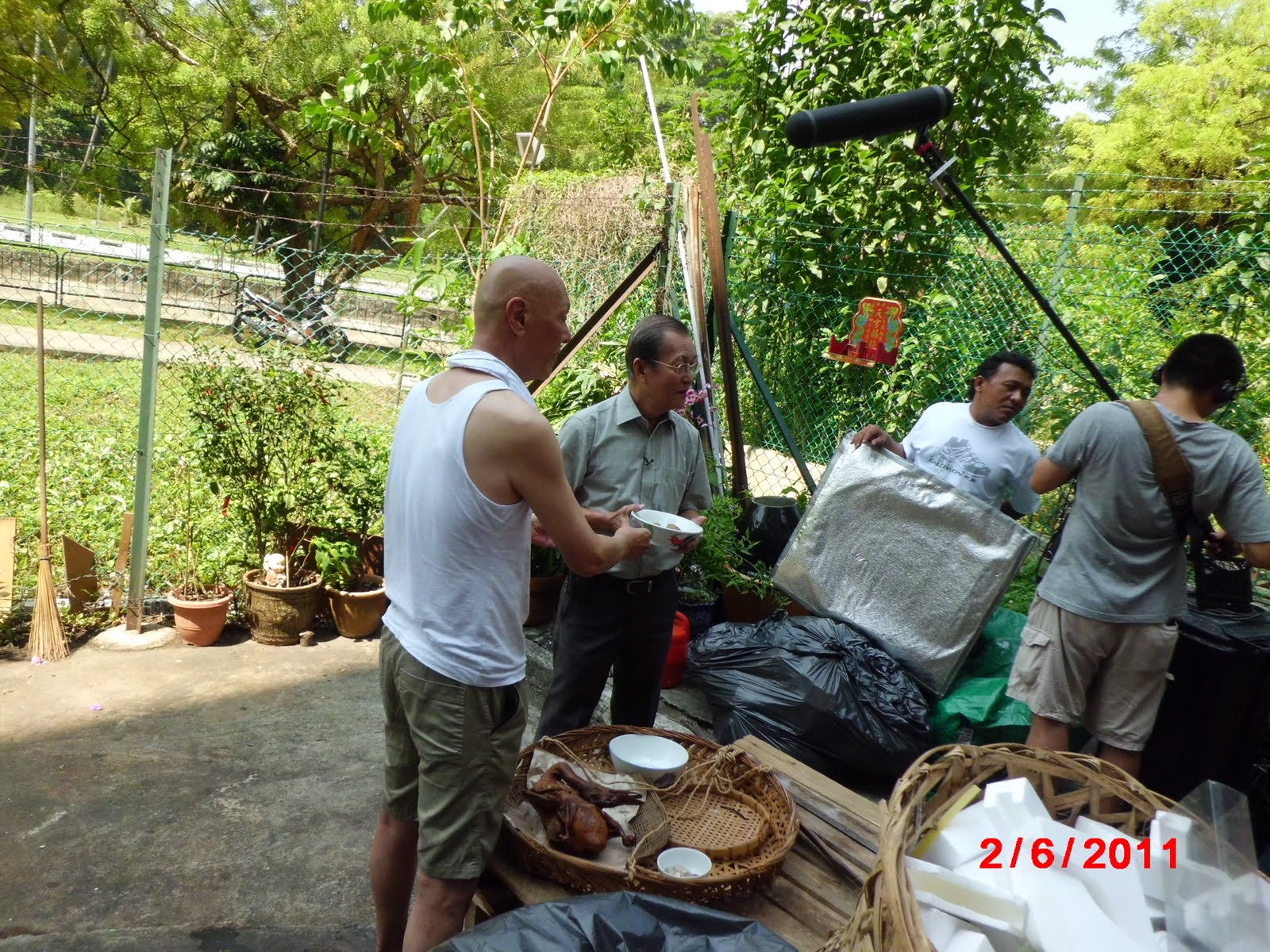

Sound, Lighting, Camera & Action!


Itinerant hawker acted by James Seah
Customer played by Philip Chew


Above picture shows only the main stuff - braised duck, egss and dices in a bowl for the game.


The Dice Game (4,5,6 or si go luck in Hokien)


Three dices are used. The customer throws the dices first into a bowl and let them roll. The dices must resulted in a paired number (say two 3s) and a single/challenged number (say 4). When there is no paired conbination, the player must continue to play the dices until there is a result. If the 3 dices show number 1, 2 and 3, or a pair with the challenged number 1, the customer loses outright. That is the odd against him. If he wins the first round, he has to continue playing until he wins the best of 3 games to claim his prize of 3 eggs. He could return the 3 eggs to play for a quarter duck, and then to half a duck and finally the whole duck. For each bet he must win the best of 3 games. The basic price per game was 30 cents for the prize of 3 eggs. A customer could pay more to play for a quarter duck instead of starting with the basic 30 cents for 3 eggs.


Fast rewind back to the 50s and 60s at Joo Chiat.


Every Sunday my home was like a club house. My friends, mostly shopkeepers in the vicinity gathered to drink beer, hard liquor and played mahjong and cards. That was where I learned all the vices as a teenager. The itinerant braised duck hawker usually arrived at my house about lunch time. His mobile stall had lor nun (eggs) and lor arh (braised ducks), plus gizzards etc. He gave free sauce(lor), cucumber and chilly sauce. Many of us took turn to play against him until somebody won a whole duck or two and some eggs. Unlike today's hawker stall where you can buy a bowl of rice or porridge, this guy had no rice at his stall. Anyway, no rice was fine with us drinkers. I remembered there was one or two occasions we won all his ducks, eggs and all. He did not mind at all for we lost to him a sum of money which could be more than the cost of his goods. The players had the satisfaction of winning the briased ducks and the hawker was happy to make more money by playing the game of dice. It was a win win situation for both. No wonder it was so popular in those days.

Friday, January 28, 2011

Yer Of The Rabbit


Wishing You A Happy & Blessed Chinese New Year of Golden Rabbits

Friday, January 21, 2011

Time Stood Still in Galle, Sri Lanka

In Galle, Sri Lanka there was a very old open shed market built in 1880 named Green Market. The building had slim rounded concrete pillars and raised cement floors with a lower passageway in the centre, separating the market into two equal parts.

I saw only local farm produce such as vegetables, chillies, carrots, pumpkins tubers, etc were sold there. Not a single item was imported. All articles were displayed for sale on the flat floor. The stallholders still used the old type of weighing scale as shown in the pictured below.

Times moved on but the Green Market did not. Business was as usual since the market first started. The only thing that changed was the stallholders. They were the new generations, probably the descendants of the old hawkers. Walking inside the market was like going back in time. It amazed me that time stood still for this 19th century market although it was within walking distance of a busy shopping street.

The hawker stalls outside the market were different. They had raised stalls and displayed their articles at eye level so that the customers did not have to look down like those inside the market.


Green Market 1880


Articles displayed on the floor


Balancing weighing scale


Metal weight in grams


Stall outside the market and busy shopping street in the background


More stalls outside the market

Friday, January 14, 2011

Why House Galle, Sri Lanka

On 1st Jan 2011 we began our new year in the air on our way to Sri Lanka. We went there with another family. At Colombo International Airport a band of musicians and dancers welcomed our arrival. We were garlanded on the way out. Our destination, Why House Resort was about 125 km away. There we were welcomed by the resort staff and garlanded another time.


At Colombo International Airport


At Why House Resort, Galle

Why House Resort has 3 acres of luxurious tropical garden with 3 different accommodations. The main house has internet access and a large airy living room in the center with a luxurious veranda. There are 2 cabanas for single person and 2 double bedrooms with separate entrace. All has private porch, air conditioning, satellite TV and a mini bar. There is also a salt water swimming pool.


Main house


Two double bedrooms with own entrance each


Cabanas for single person

We booked the whole resort for 8 days. Our group had only 10 people although the resort could accommodate 16 including children.

Activities
We swam at the pool or sat by the pool side reading story books. We played crickets with the resort staff. There was no badminton court. A net tied between 2 coconut trees was good enough for the purpose. The children enjoyed the game. At night after dinner we sat around a table at the airy and luxurious veranda to plan for the next day's meals and outings over glasses of red and white wines.


Pool activities


Cheers to tomorrow's outings


Cricket


Badminton
Meals
There was no set menu. It was up to us to decide what food we wanted to eat for each day.
Breakfast - we had fruit juices and fresh fruits followed by ah pong, thosai, Sri Lankan omelets and curry. We also had western breakfast of bread toast, jam, honey, butter, ham, bacon and eggs.
Lunch - main course was either chicken, pork or beef in Sri Lankan curry.
Dinner - main course was seafood such as crabs, prawns, lobsters, squids, fish and vegetables curry

Lobsters


Grilled mullet fish


Curry crabs


Steamed crabs


Sri Lankan dishes


Cheers to the chef and his yummy food!


Lizards


Squirrels


Birds
The resort has many fruit trees - coconut trees, jack fruit trees, banana plants and others. There were many birds of different species, lizards and squirrels too. I saw them every morning. They were used to guests there and I could move quite close to them to take pictures.
Why House Resort is the perfect hideaway for everyone who wants to relax in style away from the main stream tourist centers. It is a place for peace and tranquillity.
To be continued